
Visiting the Lofoten Islands in spring can be challenging due to the weather. However, in our opinion, it’s still a great time and less busy, of course. Benefit from our experience and read our tips:
- Weather
- Outfits/Packing
- 7 Must-Visit Places
If you are visiting during a different season, please read our complete guide with tips for winter, spring, summer, and fall:
Spring Weather (April – May)
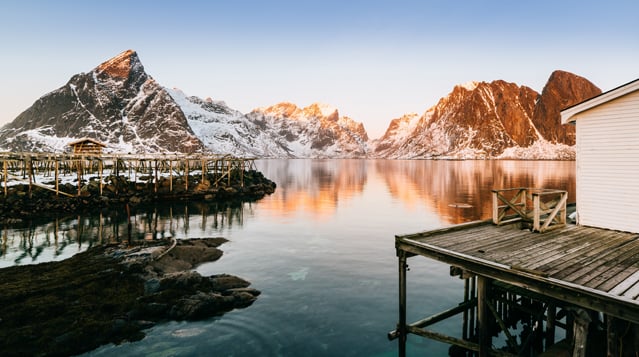
- Weather: Still chilly, snow can continue until May. April feels and looks like winter. More sunshine than in winter, however!
- Crowds: Quite reasonable, although they begin to pick up a bit as the days get longer and warmer.
- Highlights: Northern Lights are still visible until mid-April. Midnight sun begins May 26.
The months of April and May are usually still fairly chilly, while snowfall is quite common in early April in Lofoten Islands. It may also snow throughout May. Those who visit Lofoten should bring warm clothing to keep warm on crisp days and nights. Many consider this a great time to visit, as the conditions are more accessible yet you avoid the heavy crowds of the summer months.
Due to the ongoing snowfall and the added bonus of much longer days, those seeking wintery activities will not be disappointed if visiting Lofoten. You may also notice a change in the scenery, as the white snow gives way to lush green foliage in many places.
Spring also brings a welcome relief from the short days of winter, you can expect to have long days with plenty of light to make exploring Lofoten much more accessible. Lofoten’s waterways and waterfalls will be at their powerful best due to the melting snow.
Weather Details

April
April is still quite cold in Lofoten. Daytime temperatures are usually around 5 °C (41 °F), while nights often drop to 1 °C or close to freezing. Snow is still common, especially in the early part of the month, and you may see fresh snowfall even later in April.
The winter slowly fades as the days become much longer, and by mid-April there is already plenty of daylight for exploring. The snow in lower areas starts to melt, but the mountains often remain white. It is a month of change, when winter and spring meet.
May
May is milder, with daytime temperatures around 7 °C to 9 °C (45–48 °F) and nights usually between 3 °C and 5 °C. Snow is mostly gone in lower areas but can still be found on shaded mountain slopes.
The landscape starts to turn green, and waterfalls are full of melted snow. Some hiking paths may still be wet or covered in patches of snow, especially early in the month. The days are very long, and by the end of May there is already daylight almost all night.
Packing and Outfit Tips

April
April weather in Lofoten can feel like both winter and spring. It is best to bring layers so you can stay warm and dry.
- Thermal underwear or long base layers
- Warm sweater or fleece jacket
- Insulated jacket or vest
- Waterproof and windproof outer jacket
- Waterproof pants or softshell pants
- Warm hat and gloves
- Thick wool or merino socks
- Waterproof boots with good grip
- Sunglasses and sunscreen
- Scarf or neck warmer
- Backpack with rain cover
- Extra socks and underwear
- Thermos bottle for hot drinks
If you plan to hike in the mountains, bring gaiters or small spikes for icy or snowy paths. Nights and mornings can still be cold, so warm clothing is important even if the sun shines during the day.
May
In May you can pack a little lighter, but warm layers are still needed. The weather changes quickly, and cold winds are common near the sea.
- Light thermal or base layer (optional)
- Fleece or wool sweater
- Light insulated jacket or vest
- Waterproof and windproof jacket
- Hiking pants or quick-dry outdoor pants
- Hat or beanie
- Light gloves
- Hiking boots or waterproof shoes
- Comfortable sneakers for towns or dry trails
- Sunglasses and sunscreen
- Small backpack with rain cover
- Extra socks and light layers
May often feels fresh and bright, but not yet warm. It is still too early for summer clothes, so always pack something windproof and warm for evenings.
Activity Overview
The main ski season is still in full swing in April, and many resorts stay open through May. Other outdoor activities include hiking, fishing, and kayaking. While April is too difficult for self-guided hikes, in May hiking tours are more likely. However, you need to be careful, as rockfalls and avalanches can present a danger as much of the ice melts quickly and causes the terrain to be unstable in some parts.
Museums are a must-visit in spring and of course, you need a rental car to get around on your own. Check with the operators for available tours in the spring-like kayaking along the Lofoten islands coast or other Lofoten Tours.
Tip: Although the Northern Lights can still be spotted until mid-April, this phenomenon shouldn’t be the main reason to travel here in April. There are definitely better months for the Northern Lights.
7 Must-Visit Places
Let’s dive into the seven must-see spots and activities that make the Lofoten Islands a bucket-list destination in spring:
1. Svolvær | Island: Austvågøy

Original Map (c) by Kartverket, CC BY, modified
‘Wherever I stood in Svolvær and whichever way I looked, the view was just magnificent!’ Most visits to Lofoten begin in its largest town, Svolvaer, which is located along the south coast of Austvågøy. For centuries, the town served as an important port for Lofoten’s only main industry of fishing.
Today, it is still used for that, but it is equally important for bringing in visitors and tourists.

While the town has a modest permanent population of just 5,000, it can feel much bigger due to the many tourists. Its population also swells during the cod season, when many people from all over the west coast of Norway descend on the town.
As a result, there are plenty of hotels and other accommodation options in Svolvaer. Due to its many visitors, plenty of infrastructure and attractions are available at Svolvaer.
Despite its size, there is an incredible selection of restaurants, bars and cafes, which cater to both tourists and locals. You will certainly have no difficulty finding a place for a snack or a drink in Svolvaer.
There are also other amenities, such as a shopping centre, grocery store, and movie theatre.
WW2 Museum | Top Tip
One of the most popular attractions with Svolvaer is the World War 2 museum. This museum may be small. However, the level of detail and effort that has been put into ensuring that it is presented in an accurate and engaging way makes it an absolute must-visit.
The museum has over 5,000 artifacts from the Second World War, nearly all having come from the private collection of a Norwegian man named William Hakvaag.
The artifacts are displayed in such a way to really bring home the human aspect of this terrible period in the world’s history: uniforms are displayed on mannequins, making it easy to imagine how they must have looked on the young men who fought in the conflict. The variety of items also gives a fascinating and different look into the Second World War.
Some of the more unusual items include the purse of Eva Braun, Hitler’s wife, and some paintings by Hitler himself. It surely brings the conflict to life in a fascinating – if slightly unsettling – way.
Enthusiasts in particular, will be impressed by the meticulous presentation. While most of the attractions have English translations, William Hakvaag is also often there to add extra information. He will happily explain to visitors the background of his collection, as well as point out particularly interesting artifacts and pieces. It’s definitely unmissable when in Svolvaer.
2. Trollfjord

Original Map (c) by Kartverket, CC BY, modified
Departing from Svolvaer, a trip through the breathtaking Trollfjorden is one of the most popular activities, departing in both winter and summer.
Trollfjorden is a narrow corridor located off the straits of Raftsundet, and located between two imposing mountains. Popular tours through the area include whale watching, fishing trips, and sea eagle safaris.

Boat trips to this area offer jaw-dropping views as you pass through the corridor, with mountains so close on either side that you think you might just reach out and touch them. At the entrance, Trollfjord is just 100m wide.
Trolls have always had an important part in Norse mythology and are the namesake of this area. Rumour has it that the huge mountains to either side are trolls that have turned to stone after being caught in the sunlight. Maybe it is better not to touch them after all!
3. Kabelvåg | Island: Austvågøy

Original Map (c) by Kartverket, CC BY, modified
As described above, for centuries, fishing was the most important activity on Lofoten – it was how most residents made their livelihood. Even today, it remains important, although tourism has helped to diversify the industry on the islands.
One of the most famous fishing villages is the picturesque Kabelvåg on the island of Austvågøy. It has become a popular tourist destination and has a number of attractions for visitors of all ages. Visiting its attractions can also help you to learn more about the importance and history of fishing in Lofoten.
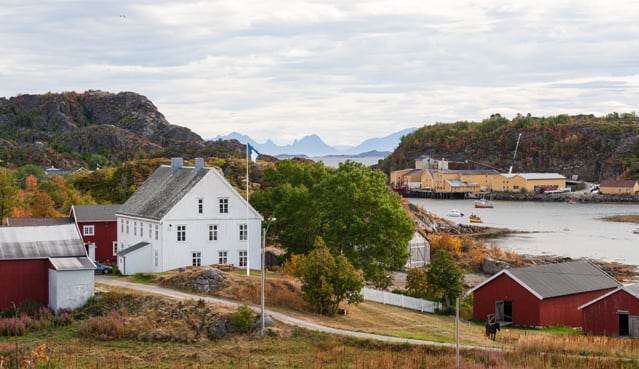
Lofoten Museum – Kabelvåg, Christoph Strässler, CC BY-SA, cropped, colored
Aquarium
Both the young and the young heart are likely to enjoy this aquarium, which also features a café and a gift shop. The aquarium shows many types of marine life commonly found off the waters of Lofoten, including cod, salmon, and prawns. There’s also the bizarrely prehistoric-looking Atlantic Wolf Fish.
The most popular attraction here, however, are the sea mammals. Outside, adorable seals delight visitors, as do the cheeky and playful otters. They are best viewed at feeding time, when their vibrant personalities are on full display!
Lofoten Museum
Easy walking distance away from the aquarium is the Lofoten Museum, which has displays of traditional Norwegian houses and gives information about life on the islands of Lofoten. As well as the houses, there are some photographs and also a video about life on Lofoten in the past.
There are also demonstrations of traditional crafts and activities, such as blacksmithing. Be sure to grab an English language brochure because not all of the attractions have English translations and it can be a tad disorientating. Well worth a short visit, however, especially if it is too rainy to enjoy the outdoor activities!
Vagan Church
This beautiful and picturesque church is the largest wooden church north of Trondheim. The church is incredibly photogenic, especially in winter when it arises from a blanket of snow. The church is still in use today, so be respectful when visiting.
The area that surrounds the church is also beautiful – keep an eye out for “Troll’s Rock” which is nearby. It’s easy to spot as it has a large Christian cross on it.
4. Å | Island: Moskenesøy

Original Map (c) by Kartverket, CC BY, modified
The most westerly point in Lofoten, this unusually named village boasts exceptional views that must be seen to be believed. It also has a number of tourist attractions and is a great launching off point for a cycling tour of the island.

Å i Lofoten by Christoph Strässler, CC BY-SA, cropped, colored
- Lofoten Stockfish Museum: It may sound like an unusual thing to have a museum for, however stockfish has been Lofoten’s most important export for centuries. For over a thousand years, fisherman have made stockfish by catching and then naturally curing the fish on drying racks over the winter months. Much of the stockfish is then exported, although plenty of it remains in Lofoten and is used in numerous traditional dishes. The stockfish museum is set out like a working fish factory – with all the sights and smells you would expect! On display are many pieces of equipment used to make stockfish, each with explanations in multiple languages. If that’s not enough, the owner of the museum is extremely enthusiastic, and wanders around giving more information in an impressive variety of languages. Upstairs, there’s also a great café to stop and also watch a short film about how to process stockfish. Although it might seem like an unusual topic for a museum, it is well worth a visit.
- Norwegian Fishing Village Museum: Learn even more about life as a fisherman over the last 250 years at the Norwegian Fishing Village Museum. Here, you can learn about how difficult life was for those who made their living through fishing in years gone by – inspect a typical fisherman’s hut, and tour a produce storeroom. While it is possible to self-guide through the museum, it is recommended to go on the official tour to really understand the exhibits, as not all of them are in English. The tours are 15 to 60 minutes in duration. Year round, they are held in Norwegian, English and Spanish, but they do offer additional languages. There are also some interactive exhibits, such as a demonstration on how to extract cod liver oil. There is also a bakery which sells delicious goods – the cinnamon rolls are a particular favourite!
5. Røst | Islands

Original Map (c) by Kartverket, CC BY, modified
The furthest flung of the Lofoten islands and located some 100km from the mainland, towards the southernmost part of Lofoten, Røst is made up of hundreds of islands, islets, and reefs.
Although it does have some permanent residents, they are few and far between – just 600 in total, although the number does climb in the fishing season, when as many as 1,500 fishermen arrive.
While the population is modest, there is a selection of good bars and restaurants to enjoy.
In the winter months, you may also catch the beautiful Northern Lights. Perhaps the best place to see them is Røstlandet, which is the highest point on the island and has amazing panoramic views.
The islands also have many interesting festivals, including The Puffin Festival (Lundefestival) in June, the music festival Querinidagene in August, and “In the Name of Cod” each March.

Rostlandet by Ian Cochrane, CC BY, cropped
Røst’s geography is perfect for exploring by bicycle, as it is very flat – the highest point in the whole municipality is just 11m about sea level. Covering an area of approximately 11.2km, one of the biggest drawcards of Røst is its seabirds, especially the beloved puffins.
Here, you will find over 3 million puffins, many near the beautiful Skomvær Lighthouse. The Skomvær Lighthouse was built in 1887 and stands an impressive 30 metres tall. Considered one of the first Atlantic outposts, it is now under the protection of the Norwegian Coastal Association.
6. Vestvågøy
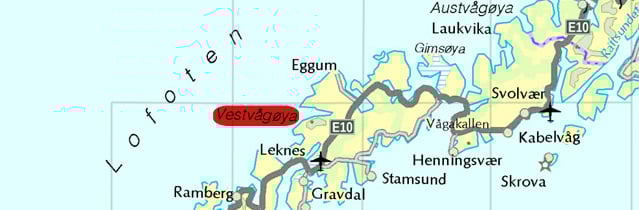
Original Map (c) by Kartverket, CC BY, modified
This island has wide open spaces, making it a favourite for those who come to get away from the hustle and bustle of the mainland and even some of the more crowded parts of Lofoten.
Although it is fairly quiet, there are still many nice shops, restaurants and bars. Interestingly, this island was once called “Lofotr”, and it was this that eventually became Lofoten, the name for the whole area.

Vestvågøy by Frode Bjorshol, CC BY, cropped
One of the main industries in Vestvågøy is farming, so there is a lot of fresh local produce that can be bought and enjoyed. Food lovers may also enjoy touring the farms to actually see how traditional produce is made.
Vestvågøy’s geography is also well suited to cycling, so one suggestion is to spend a day cycling around, perhaps with some local produce in your backpack to have a makeshift picnic. There are many, small picturesque villages on the island, and cycling between them is a great way to see them (although a car works too, particularly in bad weather!).
Another group popular on the islands are surfers – Vestvågøy boasts some of the best surf beaches, not just in Norway, but in all of Europe! Surfers from all over the world come to Vestvågøy to surf the breaks on the main surfing beach, Unstad.
Even if you are not much of a surfer, you’re bound to enjoy the beautiful beaches and fresh sea air. There are many great walks around here, or you can just relax on the beach – perhaps with a book in hand!

Norway_0567 Viking Lofoten by Alessandro Malatesta, CC BY-ND, cropped, colored
Lofotr Viking Museum
One of the most popular attractions on the island is located in Bøstad. In approximately 500AD, a Viking chieftain built an impressive home on the spot – today, the original house is no more, but the museum has reconstructed it.
The Museum is set up as a Viking adventure and is great for kids and also kids-at-heart. The adventure begins with an introduction to the life of the chieftain and his family via video. From there, visitors can tour around the house, learning about what life would have been like in historical times.
The museum is quite interactive, which adds to the fun – visitors can try Viking activities such as weaving. There are a few artifacts that were discovered in the dig of the site, but it tends to focus more on interactive exhibits and activities.
There are also outside activities, although some of them close in summer. These activities include rowing a Viking boat, and shooting a bow and arrow. Kids in particular, are sure to have a lot of fun here, where the emphasis is on learning through doing.
7. Reine | Island: Moskenesøy

Original Map (c) by Kartverket, CC BY, modified
With the very impressive title of “most beautiful village in Norway”, it is no wonder that Reine has attracted creative types, such as painters and poets, for centuries. They have been inspired by the stunning views of mountains and fjords – just as modern visitors are, too. There are only 300 permanent residents, but there is a good selection of amenities like shops and cafes.

Magical Lofoten – Reine by Christopher Michel, CC-BY, cropped
One of the most impressive sights near Reine is that of Moskenesstrømmen. From the elevated places near Reine, it is possible to get an impressive view of this incredible phenomenon, where various strong currents clash, causing a super powerful whirlpool that is both impressive and terrifying.
No wonder it inspired the dark genius, Edgar Allen Poe. For a closer look, it is possible to take a boat ride through Moskenstraumen – don’t worry, your expert guides will make sure you don’t get too close to the whirlpool!
Rorbuer – Fishermen Huts [Special Bonus Place]
One of the most recognizable sights in all of Lofoten is the beautiful wooden red fishing huts, which are strikingly beautiful against the natural environment. Originally built to offer humble lodgings to the fishermen who lived modest lives in Lofoten, today, they are one of the premier tourist attractions.

The buildings are typically two or three stories high and are dotted around the islands of Lofoten, up above the waters where the fishermen would catch their livelihood.
Today, many of them have been converted to offer accommodation for those staying on Lofoten. These restored huts cater for all interests and budgets – they range from the rustic basics with a bunk bed and gas stove, through to the ultra-luxurious.
There is possibly no better place to make your “home base” for exploring the attractions on the Lofoten islands – staying in one of these quintessentially Lofoten huts will surely be one of the highlights of your trip.
Even if you don’t stay in them, be sure to snap some photographs, as they make for beautiful, and recognisable, souvenirs of your time on the Lofoten islands.